Audio Only:
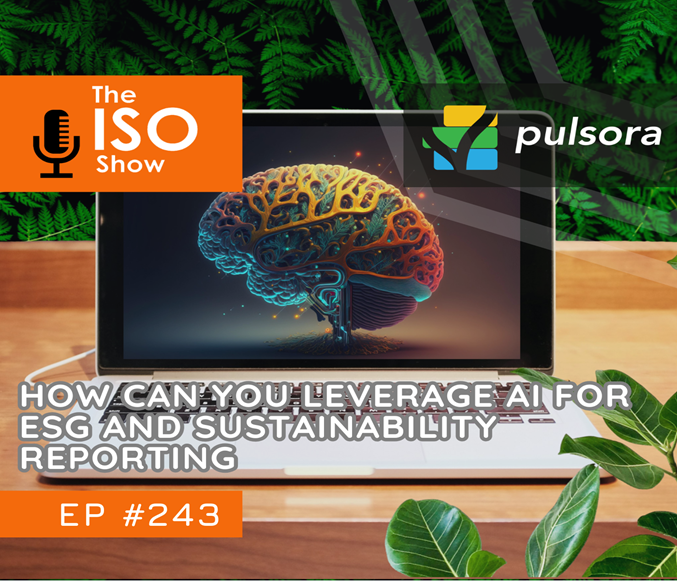
Annual sustainability and ESG reporting is now becoming a necessity for many businesses, whether driven by region specific regulations and legislation, industry expectations or client demand.
However, doing so is definitely easier said than done. It requires a complex network of data being gathered from multiple sources which then needs to be collated, analysed and summarised in a cohesive report for leadership and possible public publication.
Thankfully, there have been developments in new AI driven technology that can help ease this annual burden, allowing you to focus on utilising the results to make meaningful sustainability impacts.
In this episode Mel Blackmore is joined by Darayush Mistry, Head of Product at Pulsora, to discuss how AI can make a difference in ESG and sustainability reporting, including its benefits, pitfalls and the balance of utilising AI while considering its environmental impact.
You’ll learn
- Who is Darayush?
- Who are Pulsora?
- When did Darayush realise how AI could be utilised for ESG and sustainability reporting?
- What are the positives of AI in this space?
- Why is AI for ESG and sustainability reporting becoming more necessary?
- What are the risks involved in using AI for ESG and sustainability reporting?
- Where is AI making a real difference in reporting?
- What parts of ESG and sustainability reporting need human judgement?
- How does AI help collate data from multiple sources?
- How might regulators react to AI being utilised in reporting?
- How can businesses utilise AI while still considering it’s environmental impact?
- Darayush’s advise to sustainability leaders looking to explore AI solutions
Resources
In this episode, we talk about:
[00:25] Episode Summary – Mel is joined by Darayush Mistry, Head of Product at Pulsora to discuss the use of AI tools in ESG and Sustainability reporting, how you can leverage this technology and what risks you need to be aware of before doing so.
[02:40] Who is Darayush Mistry? Darayush has been working with enterpirise software for the past 2 decades. This technology is used by companies to help operationalise their business.
He began his career at a company called Siebel Systems, which operated in the CRM space, spending 10 years there before moving onto the world of sustainability.
Darayush recalls how everyone was so used to working from a set of spreadsheets just 20 years ago, whereas now most will use a central CRM for business operations.
This is an area that sustainbilty reporting seems to have lagged behind, with many still trying to collate their data from multiple spreadsheets and other external sources rather than having a dedicated central system. This is why he was eager to work with Pulsora, to bring similar solutions to businesses as he once had with CRM’s in the past.
[05:25] Who are Pulsora? Pulsora are an AI-forward SaaS (software as a service) platform.
The Pulsora platform helps businesses to operationalise their sustainability initiatives, which includes data collation, calculation and reporting features. This is set up for scope 1, 2 and 3 level reporting, with considerations for climate related goals, waste water monitoring, biodiversity and policy oriented information.
Darayush’s role as Head of Product means he sits at the intersection between customers and Pulsora’s engineering and design teams. His job is to ensure that whatever Pulsora created ultimately provides value to their customers in the form of successful sustainability outputs.
[07:50] When did Darayush realise how AI could be utilised for ESG and sustainability reporting? Darayush can pinpoint a time four years prior when he first stepped into a more sustainability focused role, speaking to the co-founders of Pulsora back in 2021 they were sharing experiences of using the then early versions of AI tools such as ChatGPT and Gemini.
It clicked for them then that they could do something similar for sustainability reporting, making it as easy as possible while still being accurate. It wasn’t until 2 years later that they had a product to launch with Pulsora AI in late 2024.
This initial product allowed users to write long from narrative responses for carbon disclosures. Regulations like CSRD require a comprehensive disclosure, but not everyone is an expert in parsing the data to write that, so Pulsora AI helped get past that writers block, to give people the building blocks for that professional disclosure.
[11:55] What are the positives and negatives of AI in this space? The biggest benefits include:
- Giving professionals and sustainability teams more time back to achieve their desired outcomes.
- Cutting down on spending time in spreadsheets and on calculations on an annual basis.
- Reduction of repetitive tasks
- Ease of data collection from multiple sources and locations
- Ease of data calculation
- Allowing for pre-audit of data using AI tools
- Highlighting data gaps when rationalizing the data
[17:20] Why is AI for ESG and sustainability reporting becoming more necessary? People are starting to move on from the mindset of ‘Let’s try AI’ to ‘Let’s use AI’.
Time is one of the most precious resources we have, and any tool that can help accelerate more mundane tasks so that people can focus on making results happen should be a priority.
Sustainability teams are under increasing pressure to produce tangible results, something that can be made easier with the help of AI tools.
[20:06] What are the risks of using AI in ESG and Sustainability reporting? Don’t treat AI as this magic wand, it’s a tool you can leverage. At the moment, it’s good at certain tasks, but it cannot act on its own.
In order to progress, sustainability teams need to push on the initiatives to produce results. People know their business best, and though AI can infer certain information and produce a result, it may not always be the best solution for you. You still need that human input into areas such as strategy and action planning.
Darayush reminds us of Amara’s Law: “We as humans severely overestimate technology outcomes in the short-term, and severely underestimate that in the long-term”
Don’t fall into the trap of thinking AI can do everything.
[22:30] Where is AI making a real difference in reporting? Data collection, ad-hoc sustainability reporting and providing insights into the data provided. It can also help with providing a starting point for carbon disclosures or options for various strategies that you could explore.
Currently, the biggest one is data collection, as it can help do this efficiently and consistently, allowing for improved accuracy in your overall sustainability data.
[25:20] What parts of ESG and sustainability reporting need human judgement? Darayush states that these are complementary to each other, it should never be all of one and none of the other.
There will be elements that need more human in the loop and areas where it’s required less. It’s applicable in degrees.
One example of where the human input will be higher is in completing a materiality assessment and figuring out how to execute your decarbonisation strategy, which will require your knowledge and experience of how the business operates, it’s core values and what your ultimate goals are.
AI can do the heavy lifting in areas such as sustainability reporting, as it can collate all the data and create initial reports very fast. But, at the end of the day, humans still need to understand these outputs and provide their own judgement.
‘AI’ today isn’t true AI, they’re LLM’s with a great capacity to collect data, analyse it and provide outputs that can be starting points. It cannot replace human judgement, as we provide the nuance in context and experience needed to apply those results effectively.
AI responses operate in a perfect world where everything is an easy step by step process, which we all know does not reflect reality.
[29:40] How does AI help collate data from multiple sources? Older technologies like OCR (optical Character Recognition) was the go to years ago when scanning various different documents like spreadsheets, PDF’s, receipts etc. This required specific code to be written to read these docs accurately, this would then feed into pipelines to bring this data together. This code was quite rigid, so any changes to document layouts would cause things to break.
AI in comparison is much more adaptable, it’s capable of reading much more natural language and extracting what’s required for its designated task. It also provides a much more friendly UI (user interface), meaning you don’t need an IT specialist to utilise the technology.
[33:15] How might regulators react to AI being utilised in reporting? Based on Darayush’s previous experience in the finance sector when people were using dedicated platforms for financial reporting, the regulators didn’t care where the data came from or how it was collated, they just card if it was accurate.
Regulators want transparency, accuracy and a big part of this is providing an audit trail so they can see where the data came from. They simply want businesses to follow their guidelines, the how you get from A to B is of little importance so long as the result is accurate.
If anything, the existence of these tools will raise the bar of expectations from regulators, as businesses should be able to provide the required information with these tools readily available.
[36:30] How can businesses utilise AI while still considering it’s environmental impact? – AI can certainly aid the sustainability industry in certain areas, such as reporting, but it’s a resource intensive tool.
It consumes a lot of energy and water. Like with most emerging technology, the sustainability impact usually isn’t addressed until much later. Much like with mobile phones, which create tonnes of E-waste every year, not to mention the mined material required to make them. It’s factors like this which eventually get regulators involved to help reduce the overall harm caused.
AI is yet to go through this evolution, but both regulator and consumer pressure is building to reduce the impact of AI. This will inevitably lead to innovation as companies seek to find more sustainable ways to cool data centres and reduce the resource burden.
On the flip side, AI can help save energy in other ways, such as time taken to complete the tasks for a human, which will include travelling to an office and amount of time they use a device for the task. This also has its own carbon footprint, which can comparatively be reduced by using AI to complete the tasks in minutes as opposed to hours or days.
The bottom line as of the start of 2026 is, we know there is a resource issue when it comes to AI, and companies are looking at better ways to address it as the technology develops.
[42:20] Darayush’s advise to sustainability leaders looking to explore AI solutions – Identify a problem space where you can apply AI in a measured way an start using it. The only way you can find out how it impacts you is to use the technology.
Currently, AI shines is areas such as collating data from multiple sources and locations, so if that’s an issue you’re tackling where sustainability reporting is concerned, that’s a good place to start with utilising AI.
If you’d like to learn more about Pulsora, check out their website.
We’d love to hear your views and comments about the ISO Show, here’s how:
- Share the ISO Show on Twitter or Linkedin
- Leave an honest review on iTunes or Soundcloud. Your ratings and reviews really help and we read each one.
Subscribe to keep up-to-date with our latest episodes:
Stitcher | Spotify | YouTube |iTunes | Soundcloud | Mailing List
Purchasing goods and services is a necessity for any business, whether that’s simply stocking up on office supplies, or looking for someone to manage your IT environment.
Procurement has a key role to play in keeping things running smoothly, along with facilitating the core values of businesses as priorities change, such as a commitment to ESG compliance.
In this episode, Ian is joined by Philip Ideson, Founder & Managing Director of Art of Procurement, to discuss procurement’s role in ESG compliance, the challenges procurement faces with ESG, and learn about their mission to 10X the impact of procurement.
You’ll learn
- Who is Philip Ideson and the Art of Procurement?
- What are the current trends in procurement?
- What is procurement’s role in relation to ESG?
- How do ESG deliverables fit in with the other results procurement is expected to deliver?
- What are the greatest challenges procurement currently faces with ESG?
- What is Art of Procurement’s mission to 10X the impact of procurement?
- What are the 6 principles of this mission?
Resources
In this episode, we talk about:
[00:25] Episode Summary – We welcome today’s guest, Philip Ideson, Founder and Managing Director of the Art of Procurement, to discuss the role procurement has in ESG compliance. Additionally we will dive into Philip’s mission to increase the impact of procurement.
[03:00] Who is Philip?: Philip has been in the procurement space for almost 25 years now!
He started at Ford Motor company, in direct Procurement where he was purchasing parts for car manufacture. He later moved into indirect Procurement, which is essentially everything you need to operate on a day-to-day basis i.e. office supplies, childcare facilities ect.
Philip has worked in the UK, Europe, India and has been based in the US for the past 19 years.
To get a perspective on the other side, he joined a Service Provider who provided outsourced procurement, that company later got bought out by Accenture, which was when Philip decided to go out on his own and started ‘Art of Procurement.
His podcast has been running for 9 years, and has the aim to share inspiring stories of companies who think differently about procurement.
[06:05] Hard Truth: Inside the Football Industry Podcast – Philip also co-hosts another podcast in his spare time, which was awarded the EFL podcast of the year in 2023!
Hard Truth delves into the behind the scenes aspects of football, co-hosted by the owner and Chairman of Peterborough United, it also gives an owner perspective of the football season.
[07:05] What are some of the top trends and priorities in procurement currently?
Digitisation: Procurement was an area where technological change happened relatively slowly, at least up until around 5 years ago there weren’t many tech solutions built specifically for procurement. However, a lot of money has been poured into the space, so now there’s the challenge of ‘How can we digitise?’
The problem with a lot of technology solutions is that they often become obsolete quickly, and with the rise of AI it’s trickly to keep up, let alone get ahead.
[08:10] What is something about procurement that might surprise people who don’t work in the field? Procurement gets a bad rep for trying to save every last penny at the cost of bullying suppliers. However, they are a lot more passionate around the role that suppliers can play in the growth of a business.
It’s all about marrying together the capabilities of supply chains with the needs of a business, rather than trying to squeeze every last penny’s worth out of suppliers.
[09:15] Procurement put into a box: In a lot of businesses, procurement kind of professionalised the profession based on an ROI which was tied to cost savings, because procurement sold that value proposition to get the investment, it means that that’s the only thing businesses think they can do.
Procurement gets put in this box within a business of when I need to save money, you know break the glass, bring out procurement and they can do that.
Where you actually get a much better result by working more collaboratively with your procurement team. There’s a lot more tied to business objectives than with procurement objectives, instead of focusing on what procurement can do to save you money, look at what other objectives they can help you achieve.
[10:35] What is procurement’s role with regard to ESG? – Philip was involved in a research study that was done by The Economist, where they surveyed approximately 2300 C-Suite executives, procurement and non-procurement individuals. It was revealed that ESG was the number 2 priority right now, specifically where sustainability was concerned.
Modern slavery is also becoming more of a concern.
[12:00] A fad or long term change? Priorities like this for any business are subject to the politics of the day. They are important now as that’s where a lot of focus in from many different sources, but they are likely temporary and will be dependent on geographical location and available investment.
However, the impact of emissions reporting as a result of ESG will have a longer term affect as scope 3 emissions include supply chains. More businesses will be expecting their supply chains to meet their emissions reporting requirements going forward.
[13:20] How long has procurement been doing ESG/CSR type work?: Back 14 years ago, when they had to report back on supplier diversity spend, they had very little data. It involved a lot of extrapolating data so that you have something to report back with.
More accurate data reporting has picked up in the last 6 years, and is more on an organisation by organisation basis.
The key driver for procurement involvement in any aspect of sustainability is due to regulatory requirements.
[15:00] Innovation for a better future: The digitisation and other technological advancements will allow for better ESG support, with more accurate data and reporting capabilities.
Back in the day, it may have been a case of sampling some 100 suppliers out of a pool of 10,000 listed on a simple spreadsheet, and then googling them to see which ones would be considered diverse suppliers. It short, it used to involve a lot of manual data gathering, which is rapidly getting replaced by new tech tools.
[26:20] What are the greatest challenges procurement currently faces with ESG? One of the challenges is internal. When ESG is brought to the table, decisions have to be made about selecting suppliers who would align with their ESG requirements, which is a decision that is ultimately made by the budget holder.
Procurement can do everything they can to mitigate any additional cost, but they do not decide who spends the money with who.
A lot of the role procurement can play in supporting ESG is dependent on the organisational focus on those initiatives and how well everything is communicated to all involved.
[17:20] Looking to the future of procurement: Procurement was once seen as a cost management function, now professionals like Philip are looking at how they can demonstrate the additional value they can bring to an organisation, including supporting ESG compliance.
Procurement has shifted more towards risk management, with a greater focus on risk factors such as cost and sustainability.
There’s still a lot of uncertainty around what the next 10 years will look like. Philip predicts that procurement will become a smaller, yet more impactful area than it is today.
The operating model will likely shift to a more service-based approach with a more nuanced approach to supporting businesses. Philip can see a world where sustainability and supply chains merge as third-party suppliers will have an increased effect on an organisations ability to meet its sustainability goals.
[20:30] What is Art of Procurements’ mission to 10X the impact of procurement?: Philip aims to change the mindset of procurement leaders, and get them to think outside of the box.
Procurement can have a significant impact on organisations, in the form of additional support like ESG, but also because they have a much wider field of view regarding potential suppliers.
It’s about going back to basics, asking:
- What is procurement?
- How should it operate?
- How can procurement best support businesses?
Their mission aims to rethink how procurement works, and refining how to best work with organisations to achieve their goals.
[22:25] What are the principles of this mission?: Philip highlights a few that he’s passionate about, including:
Focus on driving business outcomes: How can procurement build their capabilities around what the business truly needs? There can be conflict between an organisation and its procurement, whether that be with stakeholders or selecting suppliers. So, it’s about finding a balance between doing what can be done to further an organisations goals while also saving them money.
Procurement facilitating differentiated decision making: Procurement can offer some crucial insight into potential suppliers for organisations, but they can only do so if they have the correct data to help make those decisions. When it comes to measurable data, like many aspects of how sustainable a supplier may be, this is where procurement can help businesses make smarter decisions.
Overseeing not managing spend: Procurement should not necessarily have complete control over the spend of an organisations, but using technology they should be able to understand what is being spent and with who. It’s keeping an eye on potential risk factors with suppliers and helping organisations decide who to continue to work with.
[28:00] How are the Art of Procurement philosophically different? They see procurement as a journey, where many organisations are on a different part of the maturity curve and may need help bridging those gaps to keep moving forward.
Art of Procurement seek to accelerate that speed of maturity by working smarter with new technology, and in alignment with an organisations goals.
Procurement is facing a battle currently, where if they don’t adapt, they run the risk of losing out to purely AI driven tools. This is of course, not a concern unique to the world of procurement, it’s actively affecting HR, IT support and the creative industry in a huge way.
[30:40] Connect over common goals: Procurement professionals often want to be more collaborative than people may think. Don’t be afraid to reach out to your procurement team to see what common goals you can try to achieve.
They are there to work with you, not against you.
[32:45] Procurement and ISO: Philip has seen a lot of instances where an internal audit finding will lead to procurement success. In some cases, this may be from an identification of a need for investment in procurement, it’s seen as necessary tool for the organisation and so they approach it with that mindset in mind.
Internal Audits, a staple in the world of ISO, offer the opportunity to highlight where improvements can be made. They also compile credible evidence to put a case forward to relevant individuals, who may have not listened to previous grievances.
If you would like to learn more about the Art of Procurement, check out their podcast available on their website.
If you’d like to hear more from Philip, he also co-hosts the hard truth – inside the Football Industry podcast.
We’d love to hear your views and comments about the ISO Show, here’s how:
- Share the ISO Show on Twitter or Linkedin
- Leave an honest review on iTunes or Soundcloud. Your ratings and reviews really help and we read each one.
Subscribe to keep up-to-date with our latest episodes:
Stitcher | Spotify | YouTube |iTunes | Soundcloud | Mailing List
Did you know that only a third of the emissions reductions required to achieve the country’s 2030 target are currently covered by credible plans?
As a result, we can expect to see more mandatory and voluntary regulations that require carbon emissions reporting to verify your ESG and net zero claims.
In this episode, Mel closes out the ESG Reporting Disclosures series by explaining what Corporate Sustainability Due Diligence Directive (CSDDD) is, it’s key emissions reporting requirements, the verification requirements and who qualifies for CSDDD.
You’ll learn
- What is CSRD?
- Key requirements of CSDDD
- Key emissions reporting requirements
- the emissions verification requirements for CSRD?
- Who qualifies for CSDDD?
- The likely impact of CSDDD
Resources
In this episode, we talk about:
[00:30] Join the isologyhub – To get access to a suite of ISO related tools, training and templates. Simply head on over to isologyhub.com to either sign-up or book a demo.
[02:10] Episode summary: Mel closes out the series on ESG reporting requirements by diving into CSDDD.
[03:10] What is CSDDD? – The Corporate Sustainability Due Diligence Directive (CSDDD) is a new EU directive that promotes sustainable and responsible corporate behaviour in companies’ operations and across their global value chains.
Purpose: It aims to promote sustainable business practices, protect human rights, and address environmental challenges.
The CSDDD was adopted by the European Commission on the 23rd of February 2022 and approved by the Council of the European Union on the 24th of May 2024. The new rules ensure that companies in scope identify and address adverse human rights and environmental impacts of their actions inside and outside Europe. The CSDDD is expected to start affecting companies from 2027 at the earliest once the directive has been transposed into national legislation.
[05:10] What are the key requirements of CSDDD?:
- Human rights due diligence: Companies must identify, prevent, and mitigate adverse human rights impacts within their value chains.
- Environmental due diligence: They must assess and manage risks related to climate change, biodiversity loss, and pollution.
- Disclosure obligations: Companies must disclose their due diligence processes, findings, and any remedial actions taken.
[06:20] What are the Emissions Reporting Requirements? Under the CSDDDD, companies are required to report on their greenhouse gas (GHG) emissions within a climate transition plan.
This includes considerations for Scope 1, 2 and 3. These were explained in more detail in a previous episode on CSRD, so go check that out if you want to learn more about the individual scope requirements.
What if you fit the requirements of both CSRD and CSDDD, do you have to double report on emissions? In short – No!
The climate transition plan required by the CSDDD will be reported within CSRD reporting, as organisations just need to adhere to the CSDDD’s implementation requirements for the transition plan.
[10:10] What are the Emissions Verification Requirements? More definitive guidance on verification requirements is expected closer to 2027. Companies will more than likely need to verify the emissions data reported through CSDDD, as the directive mandates a climate change transition plan that aligns with the Corporate Sustainability Reporting Directive (CSRD), which does require companies to verify their emissions data.
[09:55] Who qualifies for CSDDD? The Corporate Sustainability Due Diligence Directive (CSDDD) applies to both EU and non-EU companies depending on their workforce size and revenue:
EU and non-EU companies (or the ultimate parent company of a group):
- With more than 1,000 employees and a global net turnover of at least €450 million in the last fiscal year; or
- Which have franchising or licensing agreements in the EU in return for royalties with more than €22.5 million generated by royalties in the EU and have a net worldwide turnover of over €80 million in the last financial year.
[11:10] What is the possible impact of this new directive? Similar to the other ESG disclosures I’ve covered over the past few weeks in this series on reporting disclosures, the impact of the CSDDD will result in 3 key impacts:-
- Increased transparency: This directive will provide stakeholders with a clearer picture of companies’ sustainability efforts, to combat greenwashing.
- Enhanced accountability: Companies will be held accountable for their environmental and social performance.
- Stimulation of sustainable business practices: The directive will encourage companies to adopt more sustainable practices, including regular reporting.
If you would like to learn more about CSDDD or inquire about the related course, please get in touch with Carbonology.
We’d love to hear your views and comments about the ISO Show, here’s how:
- Share the ISO Show on Twitter or Linkedin
- Leave an honest review on iTunes or Soundcloud. Your ratings and reviews really help and we read each one.
Subscribe to keep up-to-date with our latest episodes:
Stitcher | Spotify | YouTube |iTunes | Soundcloud | Mailing List
Businesses are coming under increasing pressure to monitor, report and reduce their energy use and carbon emissions to meet net zero targets.
As a result, we’re seeing an increase in both mandatory and voluntary regulations that require carbon emissions reporting to verify your net zero claims.
In this episode, Mel continues the ESG Reporting Disclosures series by explaining what The International Sustainability Standards Board Climate-related Disclosures (ISSB S2) are, the emissions reporting and verification requirements and who qualifies for ISSB S2.
You’ll learn
- What is ISSB S2?
- What is the scope of ISSB S2
- What are the emissions reporting requirements for ISSB S2?
- Emissions verification requirements
- Who qualifies for ISSB S2?
Resources
In this episode, we talk about:
[00:30] Join the isologyhub – To get access to a suite of ISO related tools, training and templates. Simply head on over to isologyhub.com to either sign-up or book a demo.
[02:10] Episode summary: Over the course of September, Mel will be exploring the latest climate change regulations that may affect your organisation. In this episode she dives into The International Sustainability Standards Board Climate-related Disclosures (ISSB S2).
[03:20] What is ISSB S2? – The International Sustainability Standards Board Climate-related Disclosures (ISSB S2) is a new global standard that mandates entities to provide comprehensive information about climate-related risks and opportunities.
The ISSB S2 was issued by the International Sustainability Standards Board on the 26th of June 2023 and is effective for annual reporting periods beginning on or after the 1st January 2024. The new standard ensures that companies disclose physical and transition risks and their potential impact on the move towards a low carbon economy.
[04:20] Further learning with Carbonology: Carbonology have created a half-day course which walks you through all of the various carbon reporting disclosures and sustainability disclosure reporting requirements.
If you would like to learn more, get in touch with Carbonology.
[07:00] What does ‘Acute and Chronic Physical risks’ mean in the context of ISSB S2? Climate related physical risks are risks resulting from climate change that could be event driven, so an example of an acute physical risk could arise from weather related events like storms, floods and heatwaves, which are increasing in frequency.
These could have a knock-on effect to businesses, taking a heat wave as the example, you will need to consider:
- Can your IT systems and datacentres cope with it?
- Have you got resilience built in to your operations to be able to deal with that sort of disruption to your organisation?
Chronic physical risks arise from longer term shifts in climatic patterns, including changes in precipitation and temperature, which could lead to sea level rises and reduced water availability and changes in soil productivity.
These risks could carry a weighty financial burden either through direct damage to assets, or indirectly through supply chain disruption.
[09:35] Join the isologyhub and get access to limitless ISO resources – From as little as £99 a month, you can have unlimited access to hundreds of online training courses and achieve certification for completion of courses along the way, which will take you from learner to practitioner to leader in no time. Simply head on over to the isologyhub to sign-up or book a demo.
[11:43] What does ‘Transition risk’ mean in the context of ISSB S2? This is looking for a climate related transition plan, which should include targets, actions and resources for the transition towards a lower carbon economy.
This would include actions such as reducing greenhouse gas emissions.
[12:30] What is the scope of ISSB S2? This Standard applies to:
- climate-related risks to which the organisation is exposed, which are:
- climate-related physical risks; and (ii) climate-related transition risks; and
- climate-related opportunities available to the entity.
Climate-related risks and opportunities that could not reasonably be expected to affect an organisation’s prospects are outside the scope of this Standard.
- The Standard covers:-
- Governance
- Strategy
- Climate related risks and opportunities
- Business Model and Value Chain
- Financial position, financial performance and cash flows
- Climate resilience
- Risk Management
[14:10] What are the emissions reporting requirements for ISSB S2? – Under ISSB S2, companies are required to measure and disclose their greenhouse gas (GHG) emissions across three scopes:
- Scope 1 Emissions: Direct emissions from owned or controlled sources. For example, emissions from combustion in owned or controlled boilers, furnaces, vehicles, etc.
- Scope 2 Emissions: Indirect emissions from the generation of purchased energy. This includes emissions from the production of electricity, steam, heating, and cooling consumed by the company.
- Scope 3 greenhouse gas emissions: Indirect greenhouse gas emissions (not included in Scope 2 greenhouse gas emissions) that occur in the value chain of an entity, including both upstream and downstream emissions. Scope 3 greenhouse gas emissions include the Scope 3 categories in the Greenhouse Gas Protocol Corporate Value Chain (Scope 3) Accounting and Reporting Standard (2011).
[16:20] Emissions verification requirements – Under ISSB S2, companies are required to have their reported greenhouse gas (GHG) emissions data verified.
Verification can provide users of financial reports confidence that the information is complete, neutral and accurate.
Disclosure of inputs to Scope 3 greenhouse gas emissions needs to disclose information about the measurement approach, inputs and assumptions it uses.
[18:30] Who qualifies for ISSB S2? – ISSB S2 applies to all entities that are required by law, regulation, or administrative provision to prepare financial statements. This includes, but is not limited to:
- Publicly listed companies
- Large private companies
- Financial institutions such as banks and insurance companies
- State-owned enterprises
Entities are encouraged to adopt the ISSB S2 voluntarily, even if they are not mandated by law or regulation. Early adoption is permitted and encouraged to enhance transparency and accountability in climate-related disclosures.
If you would like some help with your carbon emissions reporting, please get in touch with Carbonology.
We’d love to hear your views and comments about the ISO Show, here’s how:
- Share the ISO Show on Twitter or Linkedin
- Leave an honest review on iTunes or Soundcloud. Your ratings and reviews really help and we read each one.
Subscribe to keep up-to-date with our latest episodes:
Stitcher | Spotify | YouTube |iTunes | Soundcloud | Mailing List
As the urgency to address the climate emergency heightens, businesses are coming under increasing pressure to monitor, report and reduce their energy use and carbon emissions to meet net zero targets.
As a result, there is an increase in regulations to ensure that companies are taking the climate emergency seriously and not pay lip service to climate action.
During September, we’ll be taking a look at a few of the latest regulations that may affect your organisation, including:
In this episode, Mel Blackmore breaks down what Streamlined Energy and Carbon Reporting (SECR) is, its reporting requirements, it’s qualifiers and how it can work in tandem with other carbon management initiatives.
You’ll learn
- How do these regulations relate to ESG reporting?
- What is Streamlined Energy and Carbon Reporting?
- What are the SECR Emissions Reporting Requirements?
- Who qualifies for SECR?
- How can SECR work with other carbon management initiatives?
Resources
In this episode, we talk about:
[00:30] Join the isologyhub – To get access to a suite of ISO related tools, training and templates. Simply head on over to isologyhub.com to either sign-up or book a demo.
[02:10] Episode summary: Over the course of September, Mel will be exploring the latest climate change regulations that may affect your organisation. In this episode she dives into Streamlined Energy and Carbon Reporting (SECR).
[03:20] How do these regulations relate to ESG reporting? – ESG requirements include a commitment to sustainability, and reducing your overall impact. All of these regulations contribute towards an organisations ESG reporting requirements, as they require tangible proof to back up your ESG claims.
They will require you to provide comprehensive emissions reporting, the level of detail of which will depend on the specific applicable regulation.
[04:05] Future content to look forward to: During September Mel will look at involuntary emissions reporting schemes, but in October she will be looking into the voluntary schemes that many are already adopting as part of their Stakeholder requirements.
This will include:
[05:50] What are the SECR Emissions Reporting Requirements?: SECR has been around since April 2019, and was originally introduced to replace the Carbon Reduction Commitment Scheme.
This is a mandatory scheme, so it is a legal requirement for those that meet it’s criteria. For those that are familiar with ESOS (The Energy Savings Opportunity Scheme), it functions in a very similar way.
This scheme isn’t solely focused on reporting energy usage and carbon emissions, it’s also looking for organisations to report on efficiency measures that are undertaken on an annual basis. Which is reflected in the financial reporting that you will also have to submit.
It’s important to note that SECR has specific requirements for the disclosure of greenhouse gas (GHG) emissions and energy consumption. Emission reporting requirements vary slightly between quoted companies and large unquoted companies and LLPs.
For quoted Companies:
- Global Scope 1 and 2 GHG emissions must be reported. Scope 3 emissions reporting is strongly recommended but voluntary.
For large unquoted companies and LLPs:
- UK based Scope 1 and Scope 2 emissions and associated energy consumption. Scope 3 emissions from the combustion of fuel in vehicles or equipment not owned by the company.
[10:10] Join the isologyhub and get access to limitless ISO resources – From as little as £99 a month, you can have unlimited access to hundreds of online training courses and achieve certification for completion of courses along the way, which will take you from learner to practitioner to leader in no time. Simply head on over to the isologyhub to sign-up or book a demo.
[12:05] Who qualifies for SECR?: All UK Quoted Companies: Any company that has shares listed on the UK Stock Exchange is required to comply with SECR.
Large Unquoted Companies and Large LLPs: These are companies and Limited Liability Partnerships (LLPs) that are not listed on the UK Stock Exchange but meet two or more of the following criteria:
- Turnover: More than £36 million per annum.
- Balance Sheet Total: More than £18 million.
- Number of Employees: 250 or more employees.
These criteria ensure that SECR framework targets large organisations that have a significant impact on the UK’s energy consumption and carbon emissions. By complying with SECR, these organisations can contribute significantly to the UK’s sustainability goals.
[14:10] When is the SECR disclosure made? SECR reporting must occur alongside financial reporting, being included within annual reports and Directors’ Reports, which are then filed with Companies House.
[14:30] The importance of Accurate SECR Reporting and Carbon Reduction – The reporting process can unlock valuable insights and opportunities for operational improvements, leading to enhanced energy efficiency and reduced carbon emissions over time.
Demonstrating your organisation’s commitment to energy efficiency and carbon reduction can enhance brand perception and foster positive relationships with stakeholders, including investors, clients, and regulators.
[16:05] Integrating SECR Reporting with Other Carbon Management Initiatives – You are missing a trick if you’re keeping your SECR reporting separate from the rest of your business activities. It should be included as a part of your sustainability umbrella, and can be invaluable if you’re going for other reporting requirements such as EcoVardis and CSRD.
There’s no need to reinvent the wheel if you already have something like an Environmental Management System in place, simply weave the additional requirements in with your usual annual maintenance. Established systems will already be adhered to across the business, meaning any new requirements will soon become business as usual.
You could incorporate this as part of your Net Zero strategy, or Carbon Reduction Plan if PPN 06/21 is one of your reporting requirements. You could also incorporate this into your supply chain emissions reporting.
If you would like some help with SECR, please get in touch with Carbonology.
We’d love to hear your views and comments about the ISO Show, here’s how:
- Share the ISO Show on Twitter or Linkedin
- Leave an honest review on iTunes or Soundcloud. Your ratings and reviews really help and we read each one.
Subscribe to keep up-to-date with our latest episodes:
Stitcher | Spotify | YouTube |iTunes | Soundcloud | Mailing List





Beyond certification, we take great pride in delivering ISO consultancy and support solutions. These solutions help our clients improve their productivity and profitability in a risk-controlled way.
We are your dedicated ISO consultants for all compliance matters from internal audits to updating Health, Safety and Environmental Legal compliance.
No matter what ISO certification you are hoping to achieve, we have a specialist ISO consultant ready to work with you and your organisation. Contact our team today to get started.
Our 7 Steps to Success
The Blackmores ISO Roadmap is a proven path to go from idea to launching your ISO Management System.
Whether you choose to work with one of our ISO Consultants, our isologists®, or work your own way through the process on our isology Hub, we’re certain you’ll achieve certification in no time!
We have a proven step by step process that our ISO Consultants implement as soon as our working relationship begins. We use our specialist skills and industry knowledge to determine what is already on track and where improvements can be made. We live and breathe ISO standards, we know the standards inside out so you don’t have to.
Our ISO Consultants can help you implement systems for any ISO Standard. See the full list for specialised standards here.

What our clients have to say

We engaged Blackmores to develop our ISO 9001, 14001, and 45001 management system from scratch. Throughout the creation and development stages of our ISO journey, Anju Punetha demonstrated remarkable patience, knowledge, and understanding as our dedicated consultant.
During our internal audit preparations, Ian Battersby’s meticulous attention to detail and thorough approach ensured we were well-prepared for our external audit, which we passed with flying colours. His guidance during the external audit was invaluable.
Based on our engagement and experience, I highly recommend the entire Blackmores team. If you’re considering pursuing ISO accreditations, Blackmores should be your first choice.
Graeme Adam

The support and advise I get from our assigned auditors is immense. Forward planning for the following year is great and they are flexible and always willing to help.
Kalil Vandi

“Blackmores have assisted us almost since the start of our adoption of the ISO 9001 quality standard. Their input has improved our processes since the start, and enabled our goal of continuous improvement to be achieved. The people are also extremely easy to get on with, and they really understand our business, giving us a great deal of confidence in their advice.”
David Gibson

“Blackmores are the perfect bridge between working on your ISO as an individual or company, to being audited each year. We find that any queries we have are covered and we feel sure that we have everything as needs be before going into an external audit.”
Mandy Welsby

“We have been extremely impressed with the service and support provided by Blackmores. There knowledge and assistance through out our ISO journey has been amazing!”
Philip Hannabuss

“Blackmores have really kept us on our toes with the broad scope and level of detail they apply to our internal audit schedule. They always stay abreast of ISO standard changes and help us to adapt our processes and documents to embrace these changes accordingly. Having Blackmores shadow our external audits provides invaluable confidence and peace of mind – would highly recommend their services!”
Phil Geens

“Our ISO 27001 certification project has gone so well, that there was no doubt in who we were going to ask to help us with our aspirations of becoming ISO 14001 certified. It’s been an absolute pleasure working with Blackmores, and we are really looking forward to working with them for the foreseeable future.”
Trusted by leading organisations across all sectors, we support companies of all sizes in any location.










Listen to our Podcast
Welcome to the ISO Show podcast, dispelling myths and sharing tips for success to improve your business with ISO Standards. Join us to hear interviews with successful business leaders as they share their ISO journey with you.
Get top tips via audio master classes “ISO Steps to Success” on the most popular ISO Standards.