

Many of you will be familiar with ISO 9001, the leading Quality Management Standard, which provides a solid foundation for managing any business. However, for certain industries, ISO 9001 alone is not enough.
The built environment is one such sector, as it requires more rigorous controls to keep projects on track, ensuring safety of all involved and processes that enable documented accountability for each and every step until project delivery.
BS 99001 was introduced in 2022, not to replace ISO 9001 but rather to add to existing quality management systems for those in the built environment sector.
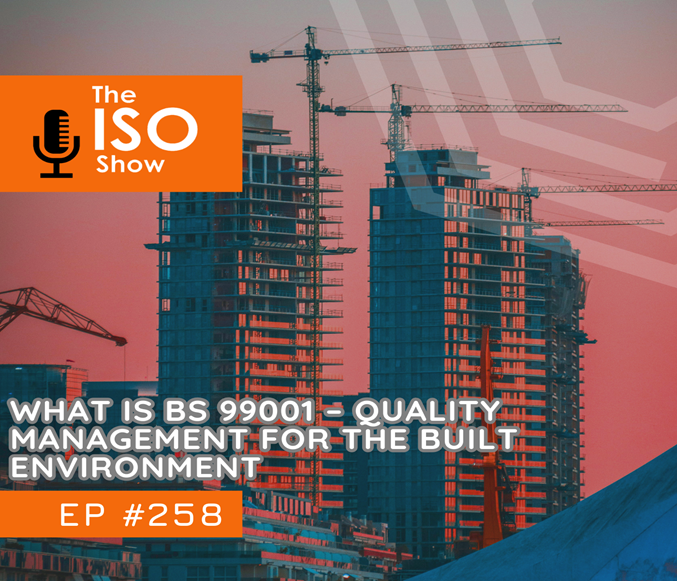
In this episode, Ian Battersby is joined by Darren Morrow, Senior Consultant at Blackmores, to explain what BS 99001 is, how it addresses challenges unique to the built environment sector and explore the clauses and how they differ from ISO 9001.
You’ll learn
- What is the built environment sector?
- Why was BS 99001 created?
- What is BS 99001’s relationship with ISO 9001?
- How does BS 99001 differ from ISO 9001?
- Exploring the clauses of BS 99001
- Where is BS 99001 going in the industry?
Resources
In this episode, we talk about:
[02:35] Episode Summary – Ian Battersby is joined by Darren Morrow to explore BS 99001, Quality Management for the Built Environment. Join them as they discuss the reason for the Standards creation, it’s relation to ISO 9001 and an overview of it’s main clauses.
[03:30] What do we mean by the Built Environment Sector? The sector covers the whole human-made environment:
- buildings (homes, workplaces, hospitals, schools, entertainment),
- infrastructure (roads, rail, bridges, utilities),
- public space (parks, squares, streets etc)
On top of that, you could also add the urban environment on a large scale, the way cities and towns are planned, developed over time, connected
Any profession involved could apply this standard:
- Design and planning (town planners, architects, interior designers, landscape architects)
- Engineering (civils, structural, M&E, transport, environmental (planning our waste, water etc)
- Construction (delivery, PMs, QSs, SMs, trades, contractors)
- Management (of estates/facilities, property developers, agents, surveyors, valuers)
- Policy, regulation, compliance (local authorities, planning officials, building control, regulatory authorities, enforcement agencies)
[05:00] Why was BS 99001 created?: Despite the widespread adoption of 9001 across the industry (and it being a prerequisite in many circumstances), there has continued to be a series of significant incidents, numerous reports and national enquiries. These all point to an issue with quality that a generic standard appears to have failed to address. When this is the case, it’s a sign that something more sector specific is necessary to avoid repeating the same mistakes.
The UK Building Safety Act is now being enforced, which has added more implications and requirements on contractors. BS 99001 can help to support compliance with this due to its focus on responsibilities, competency and accountabilities.
[09:45] What is BS 99001’s relationship with ISO 9001?: BS 99001 doesn’t modify or replace ISO 9001, it builds on it for the built environment sector.
ISO 9001 creates a solid foundation for any business, but because of this it is deliberately vague in it’s requirements. BS 99001 in comparison is very prescriptive with what it what’s businesses to do, record and evidence.
[10:30] How does BS 99001 differ from ISO 9001? BS 99001 is very much aware of the project based nature of its targeted sector, so the requirements are written with this in mind. Its requirements are written to ensure all parties involved in construction projects are included, accountability is its foundation, and it looks to help facilitate a lessons learned environment for compliant businesses.
[11:30] BS 99001 Clauses: 4 Context – We’re all used to this clause, but there’s a note to consider the nature of the interested parties, as it’s a lot more prescriptive and includes:
- Members of the public are suggested first (users of stations, tenants in social housing)
- Owners and operators of assets (ie, the built end product)
- Project funders/investors
- Project owners/sponsors
- Project teams
It also requires context documents specifically taking into account commitments to social, economic and environmental sustainability. So ESG is being embedded from the start.
These interested parties encourage open forums between not only all those involved in the actual construction, but those that will be affected by the project and end product.
This commitment to social, economic and environmental sustainability is a theme that continues throughout the whole Standard.
Some businesses that already hold certification to Standards such as ISO 14001 and ISO 45001 think they may already have all of this covered, and in many ways they would be correct, however those typically apply to the business as a whole whereas BS 99001 incorporates everything in and around the project rather than treating projects as a separate entity – which is how other ISO Standards act in this sector.
[15:40] BS 99001 Clauses: 5 Leadership – The specific requirement states:
‘Top management shall ensure that a competent person is appointed as the management representative with oversight of quality for projects the organization is involved in or plans to be involved in’
This may seem like an old-fashioned approach, however the need for competency in this sector is paramount. Organisational roles, responsibilities and authorities for Quality Management roles with clear competence and impartiality / independence criteria are explicitly stated. What was once a role that may have not held the power to stop a project like Health & Safety roles, now has that ability.
If something is raised as a quality concern, then there is a strong argument for that becoming a safety risk down the line. It’s better to fix something early on than to have it become a bigger problem, therefore, significance to the roles that point out these issues have been given the power they deserve in the project management process.
[20:00] BS 99001 Clauses: 6 Planning – Risk management is an essential part of BS 99001, Clause 6 is where the requirements for risks and opportunities is explicitly stated, however, these are references multiple times throughout the Standard.
There are specific Risk requirements to take account of are:
- Projects it is involved in or plans to be involved in;
- The process of construction and the subsequent use of the asset;
- The organization as a whole; and
- Society the economy and the environment.
Many construction companies will be tendering for multiple jobs, so it’s a good opportunity to build a robust risk register that gets added to with each project. Learning from one project should be used to help you to bid for the next one.
Keeping track of these should also be done so you can inform your interested parties of the risks involved, and any subsequent lessons learnt should also be of value to your supply chain.
One key group that often gets overlooked is the Funders, they’ll have a particular interest in the risks and to have all the knowledge available about what they’re funding. Having records to answer their questions will keep them happy or at least informed.
Objective requirements include:
- Quality objectives for each project, to reflect contractual and other requirements
- Evidence of the following considerations in objectives:
- Defined scope, time, cost and project lifecycle
- Social, economic and environmental commitments
- Collaboration with interested parties
In ISO 9001, the objectives are set from the business level, but in BS 99001 these are aimed at the project level.
[24:10] BS 99001 Clauses: 7 Support – As mentioned, people and competence is a big focus for BS 99001.Evidence for competence arrangements include:
- Project / contract specific roles and responsibilities – formally assigned
- Formal process(es) for determining competence
- Competence arrangements relating to all people working on the organisation’s behalf
There are also verification processes for all external providers, including the need for:
- Authorities for approval of operations, processes, design, production, inspection and tests
- Competence arrangements for management representative(s) specifically regarding quality
- Evidence that competence arrangements take into account requirements of interested parties
It’s up to the business to make sure they can prove people are competent for the roles they are assigned, which is why there is a lot of detail in this area.
Documented information is also key, as this provides a traceable and auditable path of accountability. Again, BS 99001 is a lot more prescriptive on this clause when compared to ISO 9001.
BS 99001 requires documentation of:
- Process(es) to ensure awareness of statutory / regulatory requirements specifically relating to documented information (eg, building information, product safety, structure, maintenance, retention timeframes)
- Approval methods and authorities for the different types of documented information
- Communication / availability / control of changes to documented information to interested parties
Now this doesn’t mean you have to drown yourself in paperwork! These can all be stored as electronic records.
This clause also sees a lot of repetition with areas such as risk, however this is simply the nature of Standards. They operate on the Plan Do Check Act cycle, you plan to do something, you do it, you check, you’ve done it, and you act on it.
This repetition is there for a reason, documenting information especially as you need to prove that your final deliverable is safe, that it’s operational and that it can be maintained.
While documentation may seem like a painful process in the early phases of a construction job, it will serve you well once the project is completed as when you get to the point of handover, everything is already done and all required information is readily available for those interested parties.
[31:55] BS 99001 Clauses: 9 Monitoring, measurement, analysis and evaluation – In ISO 9001, it’s largely up to the organisation to determine what they monitor and measure, however in BS 99001 there are specific which must be measured, including:
[28:30] BS 99001 Clauses: 8 Operation – This, like in most other Standards, is where the bulk of additional requirements sits.
8.3 Design includes:
- Re-iterates the need to appropriate design processes at organisation and project level
- Clear definitions of roles and responsibilities
- Review, verification, validation, approvals and associated competences
- Inclusion of interested partes
- Compatibility between parties and their designs
- Design maturity/novelty
- Documentation needs
- Life-cycle
- Addressing of regulatory requirements, product safety
8.4 Control of externally provided products and services – Again, 9001 allows an organisation to determine its own controls over the supply chain (according to risk).
But here, the standard specifically acknowledges the issues with supply chain which partly gave rise to it. It starts with defining the authority to approve suppliers
The rest of clause 8 (Control of production and service provision) continues in similar detailed fashion, matching similar themes
When we get to 8.7 (Control of nonconforming process outputs, products and services), we see the need to define specific roles, responsibilities and processes
It also includes specific requirements for:
- Evidence of reports to design team regarding design root causes
- Close out of corrections
- Agreements of interested parties to corrective action
- Concession/design change notifications to design authority
[35:45] BS 99001 Clauses: 9 Internal Audit – BS 99001’s internal auditsmust be risk-based and include projects. You also need to evidence audit results being reported to interested parties.
It also goes without saying that you need evidence of auditor competence.
Where Management review is concerned, you must include specific information on the performance of projects, and also evidence management review outputs being reported to interested parties.
[37:45] Where is BS 99001 going in the industry? – Currently, this is a Standard that applies more to bigger multi-million pound projects. However, Darren is seeing more of the requirements being pushed down the supply chain.
We do see that happen with the likes of ISO 9001, ISO 14001 and ISO 45001 certified organisations doing much the same with their supply chains. But BS 99001 differs as it explicitly promotes pushing its requirements down the supply chain, it’s not just a passive affect, it’s something to be actioned through leadership by promoting quality management.
[39:55] Top Tip – If this Standard is applicable you, we highly recommend you complete a Gap Analysis, even if you’re already certified to ISO 9001. This Standard differs quite a bit and ISO 9001 misses the requirements that cover the project life-cycle, sustainability and social aspects that BS 99001 focuses on.
At a basic level, ensure that your skilled people have their competences ready and available for if a client requires that information.
[41:30] The advantage of BS 99001 – BS 99001 ensure that your business can plan well and protect itself with the required record keeping. If things go wrong, you have the documentation to protect yourself, and with the additional planning requirements, you can minimise the risk involved in projects before things have a chance to go wrong.
If you are in the Construction Industry, this Standard is worth looking into.
If you’d like any assistance with implementing or supporting BS 99001, get in touch with us, we’d be happy to help!
We’d love to hear your views and comments about the ISO Show, here’s how:
- Share the ISO Show on Twitter or Linkedin
- Leave an honest review on iTunes or Soundcloud. Your ratings and reviews really help and we read each one.
Subscribe to keep up-to-date with our latest episodes:
Stitcher | Spotify | YouTube |iTunes | Soundcloud | Mailing List

Download the ISO Standards Blueprint
A step-by-step checklist for getting ISO certified
Resources
Subscribe to keep up-to-date with our latest episodes:
SoundCloud Spotify iTunes Stitcher
YouTube
Amazon Music
Stitcher
YouTube
Amazon Music