

Audio only:
Europe is only partially on track to meet its 2030 environment and sustainability objectives, and while some objectives are being scaled back, we are seeing the introduction of more regional regulations that require tangible annual sustainability reporting.
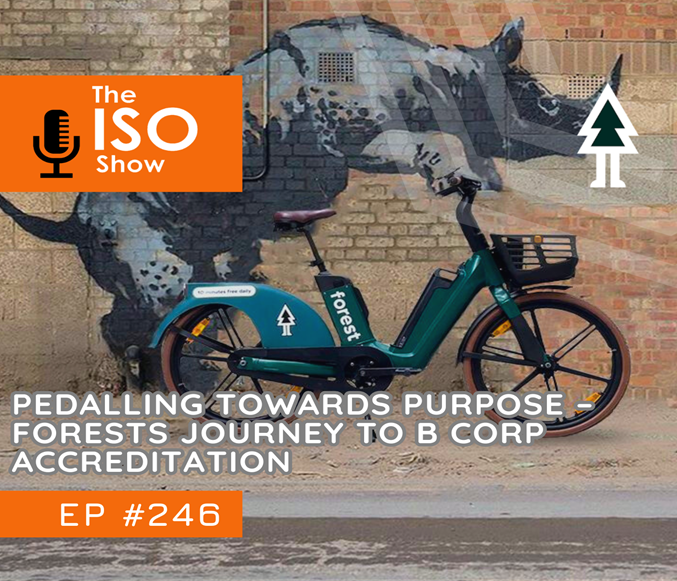
Businesses that have built sustainability into their way of working from the start are leading the charge and defining what it means to operate responsibly. As with today’s guest, Forest, an e-bike provider that is not only 100% powered by renewable energy but has also achieved the coveted B Corp Accreditation.
In this episode, Mel Blackmore is joined by Laura Elms, VP of Sustainability & Corporate Affairs at Forest, to discuss how they embedded sustainability from the start and explore their journey towards B Corp Accreditation.
You’ll learn
- Who are Forest?
- Who is Laura?
- Why was B Corp important to Forest from the start?
- What other Standards do Forest currently hold?
- What does Forest’s higher B Corp score of 99 mean in reality?
- How did Forest embed sustainability into a business from day one rather than retrofitting it later?
- How has Forest balanced growth with genuine environmental accountability?
- What does tackling Scope 3 look like in urban mobility?
- Why did they also attain Verra Validation, and why does third-party validation matter?
- How do sustainability, communications and public policy intersect in Laura’s role?
- Advice for those seeking B Corp Accreditation
- B Corp Version 7
- What role do you think sustainable transport should play in helping cities to meet their net zero targets?
Resources
In this episode, we talk about:
[00:30] Episode Summary – Mel is joined by Laura Elms, VP of Sustainability & Corporate Affairs at Forest, to explore how they lead the way in sustainability including insight into their journey towards B Corp Accreditation.
[01:10] Who are Forest? Forest is the only shared E-Bike operator to power its entire fleet with 100% renewable energy. It’s also one of the world’s first micro-mobility companies to have B Corp Accreditation and Verra Validation.
[01:40] Who is Laura and how did she get involved with sustainability? Laura admits that she had a rather non-linear approach to getting into sustainability.
She started her career shortly after graduating in financial communications and investor relations. Working in her first firm, she worked closely with a women called Caroline who went on to found Forest along with two other co-founders.
Caroline reached out to her 2 years after starting Forest and Laura felt it was a no-brainer as she had a pre-existing interest in sustainability, and had come to prefer the start-up space over a more corporate setting.
As is typical with the nature of start-ups, Laura wore many hats from the outset as it was a small team of four. Sustainability was what she was most passionate about, and has been the area she nurtured for Forest over the course of her six years working with them.
[03:40] Why was B Corp important to Forest from the start? Laura noticed that B Corp was gaining traction back when Forest started in 2020. She was curious about the intersection between B Corp and ESG, particularly from a start-up perspective.
When starting at Forest, she knew it would be a significant benefit to utilise renewable energy, but she felt like they needed to go above and beyond that. From there she researched B Corp and the costs involved, which were affordable as it’s relative to your revenue, which is a great advantage to start-ups.
She was pleased to find that Forest could cover the 5 pillars of B Corp’s credentials, not only providing bikes for urban settings but also providing excellent governance and additional benefits to their surrounding community, workers and environment.
In short, B Corp helped set the foundations for a good well rounded company that could grow.
[05:15] What other Standards do Forest currently hold? Forest currently hold ISO 9001 certification and are looking to implement ISO 14001 in the near future.
They currently operate within 18 boroughs in London, and are expanding from one central hub to several more warehouses, which is what will be covered under that ISO 14001 scope.
With B Corp as their guiding North Star, they’re confident they have all the right foundations in place to grow as needed.
[06:10] What does Forest’s higher B Corp score of 99 mean in reality? Within B Corp there are 5 pillars:
- Community
- Environment
- Governance
- Customers
- Workers
Its core focus is sustainability, but its approach is much more holistic and similar to the way ISO’s implement a system that encompasses how a business works rather than just a siloed focus on one area.
B Corp looks at a multitude if areas, such as:
- Reducing Scope 1, 2 & 3 emissions
- Looking at your supply chain
- Evaluating how your activities interact with your stakeholders
To earn a B Corp score, you need to get certain marks and then you’re scored across the 5 pillars.
Many businesses going for B Corp tend to do well in the sustainability area, but they struggle with other areas such as workers and customers.
The framework is designed to be more holistic than simply focusing on sustainability, so If you focus too much in that area, it may come at a detriment to the other pillars.
[08:20] How did Forest embed sustainability into a business from day one rather than retrofitting it later? Sustainability was Forest’s vision and mission right from the start. Their CEO and Founder had previously worked at a ride-hailing company called Cabify, and had led the Latin American operations there.
Cabify was the first mobility company to offset all its emissions, this was prior to 2020 so it was seen as though-leader in the space.
This inspired the now CEO of Forest with the concept of ‘Human Forest’, which was the idea that humans on bikes in a city can save CO2 by choosing bikes over carbon emitting modes of transport.
Having it as a core part of the business from the start meant they didn’t have to worry about budgeting road-blocks or additional approval. It was simply a part of the brand.
Laura can see why retrofitting the same level of sustainability commitment may be difficult for other businesses, as Forest had already baked in the price of renewable energy from the beginning and didn’t have to worry about that transition.
Forest do differ in that unlike other larger companies that will be showing smoother trajectories towards net zero, they’re already there. They face the unique challenge of keeping it there as they grow, as more bikes and available geographical locations means more manufacturing and bigger scope 3 emissions.
So their transition to net-zero will overall look a lot less linear.
[11:15] How has Forest balanced growth with genuine environmental accountability? Forest have managed to reduce their carbon footprint by 53% year on year, even with their continued growth.
Tackling environmental accountability can be something that gets businesses stuck in a rut, especially with any applicable regulations. As Laura quotes, often perfection is the enemy of good. Small incremental changes are better than trying to get it all right first time.
In Forest’s case, to achieve that 53% reduction they looked at a more creative solution. Rather than manufacturing brand new bikes when needed, they reached out to the wider e-bike market to those that utilised their same manufacturer and asked if they had any spare bikes.
This helped to massively bring down emissions that would have otherwise been created making new bikes, by accessing a second-hand market. This can’t be done indefinitely, but it’s a small action that has created a large impact for that year.
Forest have also worked with manufacturers to help switch to using solar energy for the production process, which they are now monitoring to see how much this reduces emissions by.
[13:50] What does tackling Scope 3 look like in urban mobility? Scope 3 for most businesses is their biggest source of emissions, typically accounting for around 80-90% of a businesses total emissions. For Forest this is closer to 100%.
They’ve also noticed that compared to 3 years ago, the emissions are slightly less for things such as production and shipping of bikes. Laura admits that this may not be entirely due to the processes themselves getting more efficient, but as by-product of improving other areas such as technology or use of office spaces to help bring down the businesses overall emissions.
At this stage, it’s getting the methodology right for scope 3, to ensure their data is as accurate as possible. This includes sending questionnaires to suppliers and making use of technology to improve data gathering and analysis.
[15:45] Why did they also attain Verra Validation, and why does third-party validation matter? Laura at the time was looking to ensure the highest level of credibility possible, which started with B Corp, ISO certification and then Verra Validation.
Verra was a leader in this space, and dominate the market in terms of carbon offsetting. Forest didn’t want to go through the whole process to sell offsets with Verra as it didn’t make sense for their business, but they did want the validation as another layer of credibility.
[17:45] How do sustainability, communications and public policy intersect in Laura’s role? London, unlike most other major cities, does not have a single unified body, instead you have to negotiate borough by borough.
Each one has the option to pick different operators and set their own requirements, which adds an extra layer of difficulty on top of existing sustainability regulations.
Forest provided the perfect solution for various London boroughs who sought to reduce their overall carbon emissions.
[19:05] Laura’s advice to organisations seeking B Corp Accreditation: Get in contact with B Corp itself. They done a lot to improve their platform, and there’s a lot you can do via the portal without their assistance. However, B Corp and their team at B Lab can give you more insight and context for the data they’re looking for.
She also recommends that you incorporate B Corp as early on as you can as it helps to set a solid business foundation.
Laura also recommends going beyond the B Corp portal after certification to reach out to the wider B Lab community, as there are a lot of fantastic brands to connect with.
B Corp will often host in-person networking meetings where certified businesses can catch-up, review progress and share new ideas.
[20:40] B Corp Version 7: B Corp have recently released (as of podcast publication) a new version of their requirements, raising standards once again.
One of the new requirements includes verification of an organisations’ emissions, which includes products.
Forest only just received their B Corp re-authentication in December 2025, and their next focus is obtaining ISO 14001 for their new warehouses. However, they do intend to stay B Corp accredited, so will likely look at meeting version 7 requirements following that.
[21:45] What role do you think sustainable transport should play in helping cities to meet their net zero targets?: Transport makes up a third of UK emissions. Getting people onto more bikes and being more active will result in a significant reduction in emissions for our cities.
When Forest asked their users: what would you otherwise have done in terms of transport if you didn’t get on one of our bikes, 11% said that they would have gone in a car or a taxi.
So an 11% modal shift, which is pretty significant! This doesn’t account for private bike owners either.
For cities, there’s a big push to get HGVs off the road and to retrofit spaces to accommodate for more cycle traffic. It’s a lot to consider and will require a lot of work, but with transport making up a third of total UK emissions, it’s worth the effort for the benefits it will bring.
If you’d like to find out more about Forest and follow along with their journey, check out the Linkedin page.
We’d love to hear your views and comments about the ISO Show, here’s how:
- Share the ISO Show on Twitter or Linkedin
- Leave an honest review on iTunes or Soundcloud. Your ratings and reviews really help and we read each one.
Subscribe to keep up-to-date with our latest episodes:
Stitcher | Spotify | YouTube |iTunes | Soundcloud | Mailing List

Download the ISO Standards Blueprint
A step-by-step checklist for getting ISO certified
Resources
Subscribe to keep up-to-date with our latest episodes:
SoundCloud Spotify iTunes Stitcher
YouTube
Amazon Music
Stitcher
YouTube
Amazon Music