

A Standard like ISO 14001 may seem more appropriate for large enterprises looking to address their environmental footprint, however it can apply to any business no matter the size.
All businesses produce waste, and we can all do more to save energy, resources and money in the process. For some SME’s, tackling resource wastage through effective environmental management can make a huge difference. Such is the case for today’s guest, Surface Print, a family owned wallpaper manufacturer managed by its 4th generation.
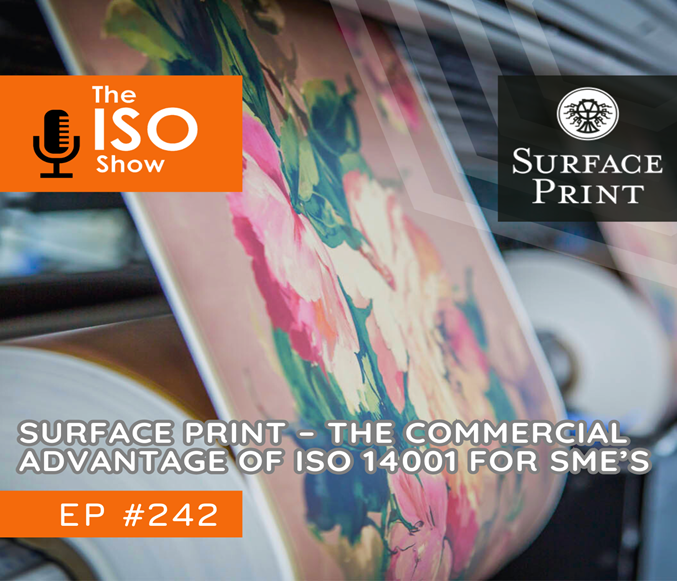
In this episode, Ian Battersby is joined by James Watson, Managing Director of Surface Print, to discuss why they implemented ISO 14001, the related resource challenges for SME’s seeking ISO Standards and benefits gained from certification.
You’ll learn
- Who is James?
- Who is Surface Print?
- Are there any other Standards Surface Print have to adhere to as a wallpaper manufacturer?
- Did those other Standards help with understanding the process for ISO implementation?
- What was the driver behind ISO 14001 implementation?
- How long did it take them to achieve ISO 14001?
- Have they considered any other ISO Standards?
- What were the challenges for an SME seeking ISO certification?
- What were the benefits of implementing ISO 14001?
- How have Surface Print leveraged ISO 14001 in marketing and communications?
- James’ top tip
Resources
In this episode, we talk about:
[02:05] Episode Summary – Managing Director of Surface Print joins Ian to discuss their journey towards ISO 14001 certification, the challenges involved with ISO implementation for SME’s and the benefits felt after certification.
[03:25] Who is James Watson? James Watson is the Managing Director of Surface Print, a wallpaper factory that is a family-owned business based in Lancashire. Both he and he sister are the current directors, he 88 year old father is still involved within the business.
They are the 4th generation in their family to be involved with wallpaper, starting with their great-grandfather, Walter Watson, who started the business all the way back in the 1880s!
[04:35] Who are Surface Print? Surface Print operate in both analogue and digital printing, with 10 large analogue printing presses and 6 state-of-the-art HP digital presses.
They have two elements to the company, with Surface Print handling 3rd party printing and white labelling for interior design brands.
The second is 1838 Wall Coverings, which is the original design branch that sells their designs worldwide.
Surface Print are not a volume printer, they focused on high-quality manufacturing with a key focus on attention to detail. All the manufacturing occurs at the UK factory.
Their typical clientele include the likes of John Lewis, Harrods and other high-end interior stores.
Their 1838 Wall Coverings branch recently had a collaboration for the past 3 years with the Victoria and Abbot Museum in London, where they were allowed access to their archive for inspiration on designs.
[07:35] Are there any other Standards Surface Print have to adhere to as a wallpaper manufacturer? Mainly it’s the Construction Products Regulation EN 15102, which is specifically for construction products used in buildings.
They also needed to get FSC certified as they were dealing with paper and wood pulp.
[08:20] Did those other Standards help with understanding the process for ISO implementation? James quite honestly admits that no, none of the previous mandatory regulations helped with understanding the ISO process.
As they understood that it was going to be quite the task, they outsourced help from Blackmores to assist with implementation. Alison Henshaw from our Team worked alongside Surface Print’s ISO committee to break down the Standard and offer valuable consultancy on aspects such as legislation.
[09:05] What was the driver for ISO 14001 Implementation? Wallpaper manufacturing is very heavy waste. Analogue machines can have up to 10% – 20% waste per production order. With that much waste, it can quickly make the entire process very inefficient.
There was also the spend on energy and gas to consider as all of those prices are increasing year-on-year. ISO 14001 could solve both of these issues while saving them a significant amount of money.
[10:15] How long did it take Surface Print to achieve ISO 14001? In total, around 12 months. It would have been quicker, but there were some administration issues with the Certification Body that delayed the final Assessment.
[11:55] Have Surface Print considered any other ISO Standards? As they’re only just into their first year of ISO 14001 certification, they’ve opted to stay focused on maturing that system before opting to go for any other Standards.
[08:20] What were the challenges for an SME seeking ISO certification? Surface Print initially struggled with the administration side of ISO 14001, things like keeping on top of document and process updates, updating the legal register etc. This is where Blackmores Consultant Alison came in to bridge the gap and ensure they kept all the necessary paperwork up-to-date.
They also needed more technical expertise in the area of environmental management. Their ISO committee weren’t ISO experts and so there was a gap of knowledge between understanding the ISO Standard and how to apply it to the business, which is where Alison helped once again to guide them on their journey.
[13:35] What were the benefits of implementing ISO 14001? Their ISO 14001 certification affects every decision made. It’s not just about environmental management, it’s about managing your business as a whole.
The Standards actively require leadership commitment, so it starts from the top down. It’s led to a more cohesive structure to making business decisions and thinking from a more environmental perspective.
There have also been cost savings. Manufacturing in the UK is generally very expensive, so the more environmentally focused you can be results in savings on energy and resources.
For example, Surface Print use a lot of electricity for both the machines and drying process involved in wallpaper manufacturing. They now measure their monthly energy usage against the rolls of wallpaper produced. They also installed solar panels which saved them a significant amount of electricity usage over the last year. They’re also investing in newer equipment to help with efficiency, making plans on how to reduce gas usage.
It’s also helped with their general business administration as documentation needs to be kept up-to-date. The whole process is now a lot more thorough, and has greatly improved their general monitoring and measurement processes.
They also have confidence in their regulatory and legal compliance, as ISO Standards have this as a basic requirement. Many opt to use a Legal Register to help keep all this information in one location.
Surface Print also found that they can answer client questions quicker due to the amount of documented information at their fingertips, this now includes more environmental based questions, which are cropping up more often.
[18:35] How have Surface Print leveraged ISO 14001 in marketing and communications? Surface Print often get asked by potential brand clients ‘What’s the benefit of working with you?’, to which they can answer with a sustainability statement which lists all of the benefits. The first point of which is ISO 14001 certification, which is a globally recognised mark of effective environmental management.
They ensure that their environmentally conscious stance is first and foremost in marketing and external communications. This is not done out of a forced obligation, Surface Print have chosen to do the right thing, which is becoming the norm. To not think about the environment, especially in high-waste industries, is generally frowned upon.
[20:25] James’ top tip for those thinking about implementing an ISO Standard – ISO implementation can cost a fair amount up-front, but the cost saving benefits within a year can supersede that investment.
You will see a lot of big improvements at the start, once your system matures you can expect to see those improvements slow in rate while still driving continual improvement at a steady pace.
With the addition of effective monitoring and measurement, those improvements are quantifiable, so you can really see the results of your investment.
[23:25] James’ book recommendation – Guinness Book of World Records
[23:55] James’ favourite quote – “You can take a horse to water, but you can’t make it drink”
If you’d like to learn more about Surface Print, check out their website.
We’d love to hear your views and comments about the ISO Show, here’s how:
- Share the ISO Show on Twitter or Linkedin
- Leave an honest review on iTunes or Soundcloud. Your ratings and reviews really help and we read each one.
Subscribe to keep up-to-date with our latest episodes:
Stitcher | Spotify | YouTube |iTunes | Soundcloud | Mailing List

Download the ISO Standards Blueprint
A step-by-step checklist for getting ISO certified
Resources
Subscribe to keep up-to-date with our latest episodes:
SoundCloud Spotify iTunes Stitcher
YouTube
Amazon Music
Stitcher
YouTube
Amazon Music