You’ve just got your head around the principals and the requirements of the Health and Safety standard BS EN 18001, and your finally comfortable with this, however, there’s discussions of migration to ISO 45001. You’re assigned with the migration process, however as you’re smiling and nodding in agreeance, you’re actually trying to digest what ISO 45001 is, figuring out what to do, and where to begin!
Hopefully the following will support you in understanding what an Occupational Health and Safety Management System is, the benefits to implementing one within your business and the next steps to achieving certification.
What is an Occupational Health and Safety Management System?
- ISO45001 is an Internationally recognised Standard designed to provide a framework for establishing an Occupational Health and Safety Management System (OHSMS);
- An OHSMS will help your business (regardless of size and nature) to integrate all aspects of health and safety, including worker wellness/wellbeing;
- An OHSMS will impel your business to manage, monitor and control accident and incidents, to ensure accidents and incidents are prevented for all persons working under tour control;
- An effective OHSMS should ensure that your business will continually measure performance and strive for improvement.
The Benefits of an Occupational Health and Safety Management System;
There are various benefits that can be gained for a business when implementing an OHSMS, these can include the following;
- Holding certification to ISO 45001 can demonstrate competency to potential new clients when tendering for new works or Frameworks;
- A well-maintained OHSMS demonstrates compliance with current and future statutory and regulatory requirements and ability to respond to regulatory compliance issues;
- Incorporating an OHSMS within your business can reduce the overall costs of incidents, downtime, disruption to operations, insurance premiums and non-attendance;
- Possessing an OHSMS within your business can demonstrate your business recognises Occupational Health and Safety as a significant priority and therefore can lead to possessing a respectable reputation within your industry.
The Next Steps…
Undoubtedly the next step is to implement an OHSMS or implement changes that have been presented from the new standard, but the key is to remember that you do not have to undertake this task unaided, and that there are consultants who are experts on implementing Management System.
Our free ISO 45001 health check will help you to evaluate how good your health and safety is, simply contact us and quote: ‘ISO 45001 Health check’
What business benefits are there in implementing ISO45001
Over 6000* people die each day from work-related accidents or diseases – that’s over 2.3 million* every year.
Additionally, there are some 340 million* occupational accidents, many of these resulting in extended absences from work.
- Diseases related to work cause the most deaths among workers. Hazardous substances alone are estimated to cause 651,279 deaths a year.
- The construction industry has a disproportionately high rate of recorded accidents.
- Younger and older workers are particularly vulnerable. The ageing population in developed countries means that an increasing number of older persons are working and need special consideration.
* source: International Labour Organisation
With effective and robust processes in place, many organisations can mitigate and / or prevent such incidents.
ISO 45001:2018 sets the framework for establishing, implementing, and maintaining an occupational health and safety (OH&S) management system, managing OH&S risks and opportunities. With ISO45001 being based on the high-level structure for all management systems, an organisation can combine systems with other standards e.g. ISO9001 and ISO14001.
ISO45001 is designed to prevent work-related injury and ill-health and to provide safe and healthy workplaces. Ultimately, its aim is to promote and protect the physical and mental health of workers, a responsibility held by any organisation.
Being an international standard, ISO45001 crosses all boundaries; geographic, political, economic, commercial and social. So, whether large or small, trading locally, nationally or internationally, ISO45001 sets the benchmark.
Good safety and health management systems and cultures help organisation to:
- Prevent injury, illness and death
- Improve reputation, resilience and results
Benefits can include:
- Improve ability to respond to regulatory compliance issues
- Improve identification of hazards and risks
- Reduce the overall costs of incidents
- Reduce downtime and the costs of disruption to operations
- Reducing the cost of insurance premiums
- Reducing absenteeism and employee turnover rates
Contact Blackmores today for more information.
Unfortunately, you can’t acquire a health and safety culture at work at the flick of a switch. A positive safety culture is about having positive values, attitudes, competencies and behaviour from employees and leaders from all levels. It takes commitment and dedication across the entire workforce.
What is a health and safety culture at work? And how do you ‘get’ one?
The new ISO 45001:2018 now includes the requirement ‘Leadership and Commitment’ (5.1), which describes the aims to develop, lead and promote a Health and Safety culture that involves all employees on the following:
- Regular communications concerning health and safety matters – Toolbox talks, intranet and meetings
- Protecting your workers – do you provide PPE (Personal Protective Equipment) i.e. high visibility jacket
- Provide a health and safety induction – make employees aware of your company health and safety controls i.e. first aider and fire drills
- Consider support for mental health issues with healthcare specialists
- Ensure relevant controls are in place i.e. lone worker and DSE Procedures
- Establish a health and safety steering group / committee to take the lead and demonstrate commitment.
Interested in how ISO 45001 can help you further with your workplace health and safety? We have a free webinar available to watch: An Introduction to ISO 45001.
If you would like more information – contact us today!

What is a Risk Assessment?
A Hazard Identification and Risk Assessment (HIRA) is simply a careful examination of what, in your line of work, could cause harm to people so that you may weigh up whether you have taken enough precautions or need to do more to prevent harm.
The aim is to ensure that no one gets hurt or becomes ill, as accidents and sickness can ruin lives and affects your business if output is lost, machinery is damaged, insurance costs increase or result in going to court.
You are legally required to assess the risks present in your workplace.
At Blackmores we are ISO consultants, we help our clients with HIRA on a regular basis as part of their ISO conpliance.
Some assessments of the relationship between hazard and risk are very precise, based on numerical assignments of values which are calculated from detailed considerations of engineering and other disciplines, other risk assessments may be more task orientated such as Display Screen Equipment (DSE) risk assessments.
The important things you need to decide are whether a hazard is significant and whether you have it covered by satisfactory precautions to ensure the risk is minimised. This needs to be checked when you assess the risks. For example, electricity can kill but the risk of it doing so in an office setting is unlikely, provided that ‘live’ components are insulated and metal casings properly earthed.
So how should you assess the risks in your workplace? HSE guidance promoted the following:
5 Step Approach to Hazard Identification and Risk Assessment (HIRA):
Here’s our 5 step approach to HIRA:
Step 1: Look for Hazards
Walk around your workplace and look for what could reasonably be expected to cause harm, not the trivial things but rather concentrate on significant hazards. Also ask your employees what they think and if they’ve noticed anything that you may not find immediately obvious.
Step 2: Decide who might be harmed, and how
This can include young workers, trainees, non-English speakers, cleaners, visitors, contractors, maintenance workers, members of the public or people you share your workplace with.
Step 3: Evaluate the risks and decide if current precautions are adequate or need improvement
When considering whether current precautions are adequate also consider if the remaining risk is tolerable or intolerable. If it’s intolerable than you need to re-evaluate the precautions and improve until the remaining risk is minimised.
Ask yourself, have you done everything required by law? But don’t stop there – your real aim is to minimise risk and to do so you may need to add further precautions.
Step 4: Record your findings
If you have more than five employees you must record the ‘Significant findings’ of your assessment, this means writing down the significant hazards and conclusions.
An example of this may be: ‘Electrical installations: insulation and earthing regularly checked and working as intended.
Your employees must also be informed of these findings.
Step 5: Review your assessment and revise it if necessary
Your business will inevitably evolve and as new equipment and procedures are introduced so too will new risks. When a significant change has been made, update the Risk Assessment as necessary. Do not do this for every trivial change.
It’s recommended that an annual Risk Assessment is conducted as a minimum to ensure that your business is as up-to-date as possible.
HIRA with Blackmores ISO Consultancy
If you are looking for any assistance with Hazard Identification and Risk Assessments within your organisation, we may be able to help. Contact us on: enquiries@blackmoresuk.com

As an ISO Consultant, we deal with identifying risks and hazards with our clients when building their ISO Management Systems. During this phase, there are often questions about risk vs hazard and what the differences are.
As ISO certifications have evolved over time, it seems like the main emphasis of the newer standards is on identifying the risks and doesn’t focus on the hazards as much.
If you would like some support on identifying the risks and hazards within your organisation for ISO compliance, then contact our team of isologists today.
Risk vs Hazard
From an ISO consultancy perspective, it’s essential to distinguish clearly between hazards and risks, as the two are often confused. A hazard is anything with the inherent potential to cause harm, for example, a process, substance, activity, or condition. In contrast, risk reflects the likelihood that the harm will actually occur, combined with the severity of its potential impact.
When we work with clients, we help them not only identify hazards within their operations but also evaluate and prioritise the associated risks. This ensures resources are directed where they can make the most meaningful difference. Understanding this distinction underpins effective risk-based thinking, a core expectation across modern ISO management system standards.
ISO 45001 – More emphasis on Risk, rather than Hazard?
ISO 45001 is the Occupational Health and Safety Management; within this standard, risks and hazards are particularly prevalent. Following the update in 2018, this standard has more emphasis on risks than hazards. This can be seen as more proactive. The requirements and structure of ISO 45001 require risks to be evaluated and remedied, rather than being hazard control.
With the inclusion of identifying OH&S (and other) opportunities, addressing the need to act to enhance or improve the management system comes out of the risk identification, hazard identification and other activities within the organisation.
Risks in ISO Standards
Risk is ‘the effect of uncertainty’, and by reducing the effect of uncertainty, we will reduce our organisation’s risk exposure. ISO 45001 sets out to do this by requiring organisations to be clear on and understand:
- What they have to do (legal requirements).
- What they chose to do (other requirements).
- How they will do it (planning, support, and operations).
- It is being done (performance evaluation).
- How to do it better (Improvement).
Risk-based thinking starts at the very beginning, when organisations are considering their context, the relevant requirements of their interested parties and the scope that the OH&S management system is to cover. Considerations should be made for both internal and external issues, and the potential impact they can have on the systems and processes.
Internal Risk Examples
These originate within the organisation and are influenced by internal processes, culture, or resources. Examples include:
- Inadequate training or competence gaps leading to unsafe work practices.
- Poor safety culture, such as low incident reporting or weak leadership engagement.
- Ageing or poorly maintained equipment increasing the likelihood of failure.
- High staff turnover resulting in inexperienced workers on critical tasks.
- Ineffective communication causing misunderstandings about safety procedures.
- Process changes introduced without proper risk assessment.
External Risk Examples
These arise from outside the organisation and are often less directly controllable, but still need to be considered and assessed.
- Supply chain disruptions, impacting the availability of safe equipment or PPE.
- Changes in legislation requiring rapid adjustment to safety controls.
- Extreme weather events affecting site safety or access.
- Contractor performance issues, where third-party practices don’t meet required standards.
- Economic pressures, leading to reduced budgets for maintenance or safety improvements.
- Technological changes requiring new competencies or introducing new hazards.
When identifying external and internal issues, and needs and expectations of interested parties, there may be a risk source that will require assessment and action as required.
As with all risk-related areas, planning to address should be proportionate to the perceived level of risk identified and the objectives of the organisation.
Hazards in ISO Standards
Whilst considering all potential risks (to OH&S performance), focus should be on those hazards that are most likely to occur or have the most impact.
Hazard Examples include;
Physical Hazards
- Working at height (ladders, scaffolds, roofs)
- Moving or rotating machinery
- Noise, vibration, or extreme temperatures
- Slips, trips, and falls from poor housekeeping or wet floors
- Electrical hazards from damaged cables or faulty equipment
Chemical and Biological Hazards
- Exposure to hazardous substances, fumes, dusts, or solvents
- Poor storage, handling, or mixing of chemicals
- Bacteria, viruses, moulds, or other biological agents
- Contact with waste, bodily fluids, or contaminated materials
Other Hazards
- Excessive workloads, stress, bullying, or poor organisational culture
These examples support a thorough hazard identification process aligned with ISO 45001’s proactive, risk-based approach.
Reduction and/or prevention of undesired effects will help the organisation achieve its goals and objectives and continual improvement.
Risks and Hazards in ISO Certifications
Awareness of these sources of risk, which have the potential to occur or are known actual events and consequences, can lead to both risk and opportunity. Identifying and determining the risks and opportunities can support the organisation at both its strategic and operational levels.
Contact Blackmores today for more information.

Top Management and Leadership within ISO 45001, what does this mean / require?
ISO 45001 places greater emphasis on management’s ownership and commitment to the organisation’s OH&S, it is central to the standard’s effectiveness and integration.
Unlike OHSAS 18001, that delegated responsibility to safety personnel, ISO 45001 requires the incorporation of health and safety in the overall management system of an organisation, driving top management to have a stronger leadership role in the safety and health program.
Under ISO 45001 top management are required to demonstrate that they engage in key OH&S management system activities within the organisation.
This requirement includes the active development, leading and promoting a culture of safety at work, and protecting workers from reprisals when reporting incidents. Top management will have to demonstrate involvement rather than delegation, and top management should be seen by all workers as being actively involved and demonstrating their commitment.
There is a greater focus on top management to ensure that there is consultation and participation of workers (formal and informal) in the development, planning, implementation and continual improvement of the OH&S management system.
ISO 45001 and Engagement of Managers
With ISO 45001, the safety culture of the organisation must be supported through the engagement of management with workers and demonstrated through a top-down emphasis. Instead of providing oversight of the program, management a required to be true safety leaders. Protection of workers, as well as performance improvements, are roles of leadership under the new ISO 45001.
Elements to Encourage Management and Leadership within ISO 45001
Top management have the responsibility to ensure that the importance of effective OH&S management is communicated and understood by all parties and ensuring that the OH&S management system can achieve intended outcomes. This can include:
- Ensuring alignment of the OH&S management system with the organization’s business objectives
- Ensuring necessary resources are available
- Encouraging workers (other interested parties) to get actively involved in improving OH&S performance
- Involving everyone in OH&S decision making, promoting open discussions
- Clearly communicating that improvement and not blame is the objective
Clear and consistent Leadership is required. OH&S management is everyone’s business; it involves everyone, from the highest level down throughout the organisation, including temporary as well as permanent workers, visitors and neighbours. It also has to be across all areas of the organisation, departments and divisions, to ensure the development of collaborative and engaging relationships.
Contact us at Blackmores for more information on engagement and leadership in ISO 45001
Context of the organisation, what does this mean?
BS ISO 45001 Context of the organization (clause 4), covers the following:
- Understanding the organization and its context
- Understanding the needs and expectations of workers and other interested parties
- Determining the scope of the OH&S management system
- OH&S management system
It within this clause that companies will begin to look, review and assess what they do, where they are in the market place and, particularly in respect of Health and Safety who could be harmed or affected by their activities.
Understanding the organization and its context
As part of the new common structure, with ISO 45001, the organisation must look beyond their own health and safety issues and consider what the society expects from them, in regard with health and safety issues.
Determination of issues that could affect the business can be undertaken in a number of ways and will be different for each business, based on size, complexity, scope of operations, etc.
A structured approach can be through methods such as:
- SWOT (Strengths Weaknesses Opportunities Threats), can be used by organizations to look inward at themselves
- PESTLE (Political, Economic, Social, Technological, Legal, Environmental), can be used to identify external issues that could affect the organization
These methods can also support in the identification of business objectives and improvement areas.
Understanding the needs and expectations of workers and other interested parties
Here, organizations are to determine those (relevant) interested parties that could affect or be affected by the organization and its OH&S management system, along with their needs and expectations that could become compliance (legal) obligations.
Relevant interested parties can include; staff (workers at any level), customers, legal and regulatory authorities, owners, shareholders, etc.
Also consider Contractors and Suppliers used, how work can affect others in surrounding areas e.g. neighbours, public, visitors, etc.
Some requirements / obligations will be mandatory e.g. Laws, Regulations, others agreed e.g. Contracts.
Determining the scope of the OH&S management system
Following determination of the external and internal issues and interested parties (above), the organization can then determine the scope of the OH&S management system.
There is an element of freedom and flexibility in defining the boundaries, however, it should be noted, organizations cannot:
- exclude activities, products and services that have / can impact its OH&S performance
- evade legal and other requirements
OH&S management system
The organization will determine, implement and maintain the processes required to fulfil the requirements of BS ISO 45001. These processes should be aligned and integrated throughout the organization e.g. Procurement, Operations, HR, etc. to ensure that everyone is aware and working towards the OH&S performance.
Where organizations have additional management system standard certification it may have covered some of these areas, however, a review will identify whether OH&S specific details have been determined.
If you would like to find out more – contact Blackmores today!
How is ISO 45001 aligned with other ISO standards e.g. ISO 9001, ISO 14001, and minor differences?
ISO 45001:2018 is based on Annex SL – the high-level structure that implements a common framework to all management systems, i.e. it applies a common language across all standards.
This helps to keep consistency, supports alignment of different management system standards, e.g. ISO9001, ISO14001, etc.
Organisations can find it easier to incorporate their OH&S management system into core business processes and get more involvement from senior management.
The standard(s) are written in such a way that by following clause by clause, a methodical approach is achieved.
Structure of BS ISO45001, highlighting minor difference / requirements:
- You must look beyond your own health and safety issues and consider what society expects from you, regarding health and safety issues.
- Here we come across the term ‘workers’ identified within interested parties
- Consider use of Contractors and Suppliers, how work can affect others in surrounding areas e.g. neighbours, public, visitors, etc.
- Leadership and worker participation
- Management / Senior Leaders endorsement of the OH&S Policy is no longer enough; they must now lead by example and demonstrate their commitment and engagement in key OH&S management activities.
- OH&S Policy now requires five specific commitments, including commitment to consultation and participation of workers
- New / enhanced requirement for Consultation and participation of workers, workers (non-managerial) – must be involved (consultation and participation), supporting improvements in processes, identification of hazards and risks.
- Planning
- Risk-based thinking – you must demonstrate you have determined, considered, and take action to address any risks and opportunities.
- Determination of applicable legal and other requirements; this can result in identification of risks and opportunities
- As part of planning, determination and assessment of risks and opportunities should be undertaken before change implemented
- Support
- More emphasis on competence, particularly with identification of hazards
- Communication with interested parties – internal and external; and taking into account diversity needs; ensure views of external interested parties are considered when establishing communication process
- Operation
- Operational planning and control – eliminating hazards and reducing OH&S risks, managing change, management of procurement e.g. Contractors, outsourcing, to ensure conformity to OH&S management system
- Emergency preparedness and response to ensure you can respond to potential emergency situations; these will have been identified within Planning, or will feed back for assessment if not previously picked up
- Performance evaluation
- Monitoring and measurement equipment (e.g. calibration) is located in section 9.1.1
- Evaluation of compliance – similar to ISO14001
- Management review; information on performance and trends includes, Incidents, consultation and participation of workers,
- Management shall communicate relevant outputs of management reviews to workers (and/or representatives)
- Improvement
- Establishment, implementation and maintenance of process for reporting, investigating and taking action, to determine and manage incidents and nonconformities
- Involve workers, and other interested parties, in the evaluation and corrective action to eliminate root causes of incidents / nonconformities
Blackmores UK can support you in migration or implementation of ISO45001, please contact us for more information.
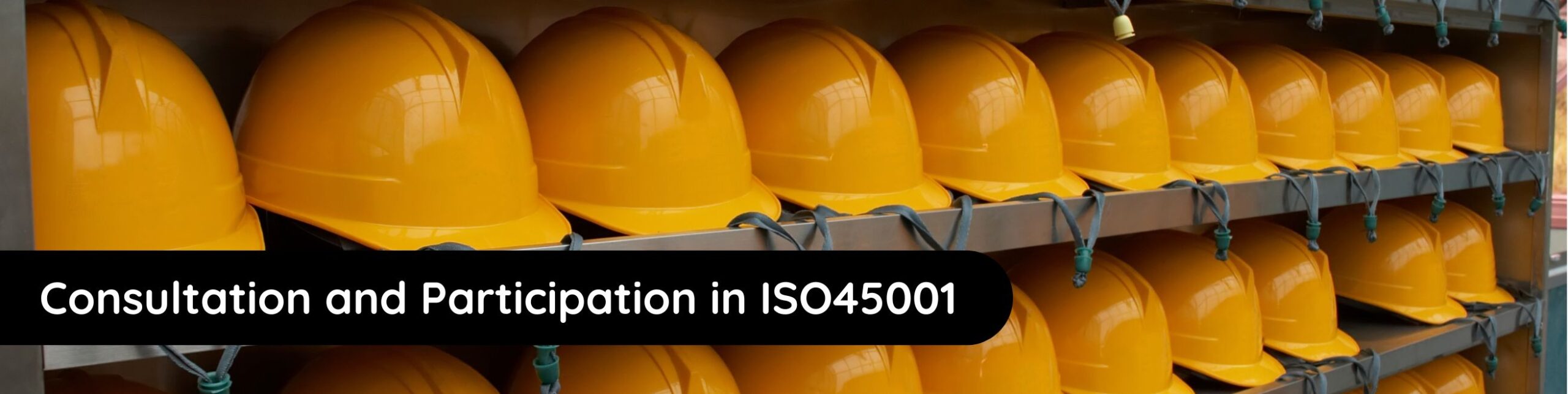
Consultation and Participation is the joint decision-making and discussion process between workers and management. It was embedded within OHSAS 18001 and further included in ISO 45001:2018. But what does the process involve and why is it important?
Consultation and Participation of workers (ISO 45001, Clause 5.4) is significantly enhanced from the requirement within older standards, where this was limited to hazard identification and consultation on changes.
When it comes to consultation and participation, ISO 45001 expects occupational health and safety aspects to be fully embodied within the organisation’s structure. This includes a greater degree of employee participation in the risk identification, hazard control and development of systems. All workers should be aware of their responsibilities and work together to meet the organisation’s health and safety goals. Everyone, including both workers and leadership, is responsible for safety.
If you are looking for further advice or want to discuss your ISO 45001 journey with our consultants, contact the team at Blackmores today.
What does Consultation and Participation imply in ISO 45001?
Consultation implies two-way communication, so workers (or their representatives when appropriate) can provide feedback to be considered by the organisation before making a decision.
Consultation implies:
- Seeking workers’ views before making decisions that affect health and safety.
- Engaging employees in discussions on policies, objectives, controls, and changes.
- Ensuring information is communicated clearly so workers can contribute meaningfully.
Participation implies the contribution of workers (or their representatives), including non-managerial workers, to decision-making related to OH&S performance and to proposed changes.
Participation implies:
- Involving workers directly in hazard identification, risk assessment, and incident investigations.
- Encouraging them to report hazards, suggest improvements, and raise concerns without fear.
- Allowing their involvement in audits, development of procedures, and decision-making processes.
Together, consultation and participation foster a strong safety culture, ensuring the OH&S system reflects real workplace conditions and benefits from the people closest to the risks.
What Does the Term Worker Mean in the Consultation and Participation Clause?
In the context of ISO 45001, ‘The Worker’ is defined as the person working under the control of the organisation, this is at all levels and includes contractors.
To facilitate the process of consultation and participation, the organisation must provide the required mechanisms, simply identified as:
- Time, training and resources
- Removal of obstacles or barriers, e.g. language, literacy or fear of reprisals
The provision of training to workers at no cost and during normal working hours could remove barriers to their participation.
Consultation and Participation of Workers in the OH&S Management System for ISO 45001 Certification
The involvement of workers in the OH&S management system, along with the processes to support, is a key requirement for an effective management system, which will lead to the achievement of your ISO 45001 certification. This involvement enables the organisation to make informed decisions and increase worker engagement.
Mechanisms can vary based on organisations, this can include,
- The inclusion of all workers in smaller organisations
- Workers’ representatives within larger organisations
- Being involved with the policy, setting objectives
- Suggestion schemes – formal and informal, along with communication on whether action is to be taken
- Focused team meetings and/or workshops
- Briefings and discussion forums, worker surveys, cross-functional groups
- Review of existing arrangements and continual improvement projects
- Hazard identification and risk assessment participation to ensure appropriate working conditions
Considerations should also take into account the methods, language and location for consultation and participation.
Worker involvement on day-to-day activities, along with those closest to the risk, provides an insight into actual issues. However, Consultation and Participation should be effective and proportionate to the organisation; not everyone is required to be involved, nor should every suggestion be acted upon.
Implementing Effective Consultation and Participation for ISO 45001
The organisation should determine the best and appropriate ways to implement effective consultation and participation, and whether more formal mechanisms, e.g. H&S committees, are required. It is important that once the mechanisms have been set up, they are supported by Management.
Why is Consultation and Participation Important?
Consultation and participation means that workers and managers work together to create a strong safety culture, ensuring the OH&S system reflects real workplace conditions and benefits from the people closest to the risks.
Consultation and participation are vital not only in becoming ISO 45001 compliant but also because they make the OH&S management system more effective, realistic, and sustainable.
1. Workers understand the real risks.
Those doing the job daily have first-hand knowledge of hazards and operational challenges, making their input essential for accurate risk assessments and practical controls.
2. Empowerment, commitment and ownership.
When workers are genuinely involved in safety decisions, they are far more likely to support and follow the resulting procedures.
3. Better communication and early problem-spotting.
Participation encourages open dialogue, helping organisations identify issues sooner and prevent incidents before they occur.
4. Builds a positive safety culture for everyone.
A workplace where people feel heard by management fosters trust, reduces resistance to change, and supports continuous improvement.
Final Thoughts on Consultation and Participation
Consultation and participation encourages a two way decision making process when it comes to risk assessment and hazard identification. Making joint decisions with workers is more likely to be effective for the development, planning, implementation, performance evaluation and actions for improvement of the OH&S management system, as workers are the key interested party.
Contact Blackmores today for more information about this topic!
So why change from OHSAS 18001 to ISO 45001?
Inevitably, there is risk in the workplace, regardless of the industry, whether we like it or not. However how businesses mitigate risk, can make the all the difference when it comes to protecting the health, safety and well-being of employees. OHSAS 18001 has been around for 20 years, and it has taken almost that long for countries around the world to agree on what ‘Best Practice’ is when it comes to managing health and safety in the workplace.
The long-awaited standard, includes contribution from 70 participating national bodies, and covers all the requirements of a Health and Safety Management System. Why is this is this standard so important then?
Well you only need to look at national (UK) and international Health and Safety work related injury statistics to demonstrate that an international standard to support global improvement in health and safety preventing work-related injuries and deaths is long overdue. Here are some of the facts:-
- Every 15 seconds, 150 workers have an accident – that’s 317 million accidents a year.
- Over 6000* people die each day from work-related accidents or diseases – that’s over 2.3 million* every year.
- Additionally, there are some 340 million* occupational accidents, many of these resulting in extended absences from work.
(source*: International Labour Organisation)
Needless to say, business in the UK and overseas have still got a long way in terms of health and safety.
Contact Blackmores today to learn more about ISO 45001
At Blackmoes, we are ISO 45001 consultants. We help organisations all over the UK and world wide when they embark on a journey to gain their ISO 45001 certification. But what is ISO 45001:2018? How can it help your business? and what are the success factors?
In our Introduction to ISO 45001, we answer all of these questions and provide an overview about this certification. If your businesses is in the midst of navigating the creation and Implementation of an internal management system to help you gain your ISO 45001 certification, and you would like some expert guidance from a consultant you can trust, contact our team today.
Webinar: An Introduction to ISO 45001:2018
This webinar was held on the 27th June 2018 when the standard was last updated. We’ve gone in to depth about the following:-
- What is ISO 45001:2018? – More about this international standard and how to build a management system for managing occupational health in your workplace.
- What’s the difference between ISO 45001 and OHSAS 18001? – The replacement process and how the two overlap.
- SWOT and PESTLE – The wider environment and how to take external elements into consideration when creating a management system for ISO 45001.
- What are the success factors of ISO 45001? – Focusing on the factors you need for successful implementation.
What is ISO 45001:2018?
ISO 45001: is the globally recognised Health and Safety Standard. Occupational health and safety in the workplace is always a major concern for all organisations. Having an occupational health and safety management system will help you to protect your most important asset; your people.
ISO 45001 provides a robust set of requirements designed for improving workplace safety in organisations and supply chains, with the aim of reducing workplace injury and illness.
ISO 45001 replaces BS OHSAS 18001, the former British standard for workplace health and safety. If you are already certified to OHSAS 18001, you will have three years to migrate to the new standard.
Why is ISO 45001:2018 Important?
Hazard and Risk Identification – ISO 45001 enables organisations to systematically identify hazards, assess associated risks, and apply effective control measures—resulting in a measurable reduction in workplace injuries, illnesses, and incidents.
Commitment to your People – Adopting ISO 45001 sends a clear message to both employees and external stakeholders that the organisation is genuinely committed to safeguarding worker health, safety, and overall wellbeing. This not only enhances morale and staff retention but also strengthens the organisation’s reputation.
Legal Compliance – The standard also supports legal compliance by ensuring conformity with relevant OH&S legislation and regulatory requirements. Its proactive, risk-based approach can further lead to operational efficiencies and may contribute to reduced insurance costs over time.
Build the Resilience of your Organisation – By embedding emergency preparedness and response protocols into the management system, ISO 45001 helps build organisational resilience and ensures a swift, coordinated reaction to safety-related threats or crises.
Continuous Improvement for your Organisation – Importantly, ISO 45001 follows the Plan-Do-Check-Act (PDCA) cycle, promoting continual improvement and long-term enhancement of health and safety performance across the organisation.
How Blackmores can help you to achieve ISO 45001 certification
Blackmores are trusted ISO 45001 consultant with a weath of industry knowledge and experience. We work closely with our clients to ensure their success no matter what industry they work in or the size of the organisation. For more information about how we can help you with ISO 45001, please contact us: enquiries@blackmoresuk.com





Beyond certification, we take great pride in delivering ISO consultancy and support solutions. These solutions help our clients improve their productivity and profitability in a risk-controlled way.
We are your dedicated ISO consultants for all compliance matters from internal audits to updating Health, Safety and Environmental Legal compliance.
No matter what ISO certification you are hoping to achieve, we have a specialist ISO consultant ready to work with you and your organisation. Contact our team today to get started.
Our 7 Steps to Success
The Blackmores ISO Roadmap is a proven path to go from idea to launching your ISO Management System.
Whether you choose to work with one of our ISO Consultants, our isologists®, or work your own way through the process on our isology Hub, we’re certain you’ll achieve certification in no time!
We have a proven step by step process that our ISO Consultants implement as soon as our working relationship begins. We use our specialist skills and industry knowledge to determine what is already on track and where improvements can be made. We live and breathe ISO standards, we know the standards inside out so you don’t have to.
Our ISO Consultants can help you implement systems for any ISO Standard. See the full list for specialised standards here.

What our clients have to say

We engaged Blackmores to develop our ISO 9001, 14001, and 45001 management system from scratch. Throughout the creation and development stages of our ISO journey, Anju Punetha demonstrated remarkable patience, knowledge, and understanding as our dedicated consultant.
During our internal audit preparations, Ian Battersby’s meticulous attention to detail and thorough approach ensured we were well-prepared for our external audit, which we passed with flying colours. His guidance during the external audit was invaluable.
Based on our engagement and experience, I highly recommend the entire Blackmores team. If you’re considering pursuing ISO accreditations, Blackmores should be your first choice.
Graeme Adam

The support and advise I get from our assigned auditors is immense. Forward planning for the following year is great and they are flexible and always willing to help.
Kalil Vandi

“Blackmores have assisted us almost since the start of our adoption of the ISO 9001 quality standard. Their input has improved our processes since the start, and enabled our goal of continuous improvement to be achieved. The people are also extremely easy to get on with, and they really understand our business, giving us a great deal of confidence in their advice.”
David Gibson

“Blackmores are the perfect bridge between working on your ISO as an individual or company, to being audited each year. We find that any queries we have are covered and we feel sure that we have everything as needs be before going into an external audit.”
Mandy Welsby

“We have been extremely impressed with the service and support provided by Blackmores. There knowledge and assistance through out our ISO journey has been amazing!”
Philip Hannabuss

“Blackmores have really kept us on our toes with the broad scope and level of detail they apply to our internal audit schedule. They always stay abreast of ISO standard changes and help us to adapt our processes and documents to embrace these changes accordingly. Having Blackmores shadow our external audits provides invaluable confidence and peace of mind – would highly recommend their services!”
Phil Geens

“Our ISO 27001 certification project has gone so well, that there was no doubt in who we were going to ask to help us with our aspirations of becoming ISO 14001 certified. It’s been an absolute pleasure working with Blackmores, and we are really looking forward to working with them for the foreseeable future.”
Trusted by leading organisations across all sectors, we support companies of all sizes in any location.










Listen to our Podcast
Welcome to the ISO Show podcast, dispelling myths and sharing tips for success to improve your business with ISO Standards. Join us to hear interviews with successful business leaders as they share their ISO journey with you.
Get top tips via audio master classes “ISO Steps to Success” on the most popular ISO Standards.